


Markdown in AI workflows: useful, but not proof of quality
Markdown matters to publishing professionals partly because it appears at interfaces with AI tools. Headings and lists can separate tasks, sources, and expected output in a prompt. OpenAI's documentation explicitly describes combining Markdown structure with XML tags for such purposes. This establishes neither universal superiority nor that every model processes Markdown best. S23
Document extraction can also produce Markdown representations. Microsoft's document-analysis documentation, for example, describes Markdown output that additionally uses HTML structures for complex tables and figures. An extraction called Markdown is therefore not necessarily pure CommonMark. Downstream processing must inspect the actual profile and structures present. S24
Structured text can be useful in retrieval-augmented generation: sections can serve as processing units, while code and tables receive separate treatment. A practical implementation should also retain document identifiers, source locations, and, where applicable, page references beyond visible prose. Splitting a table from its notes during chunking can destroy their relationship. This is a pipeline issue, not simply a question of whether the text remains valid Markdown.
A meaningful comparison of input formats uses identical content, documented parsers, fixed evaluation rules, and concrete tasks. This does not justify blanket claims such as "Markdown always saves a particular number of tokens" or "XML is inherently worse for AI". Token cost and response quality require separate measurement.
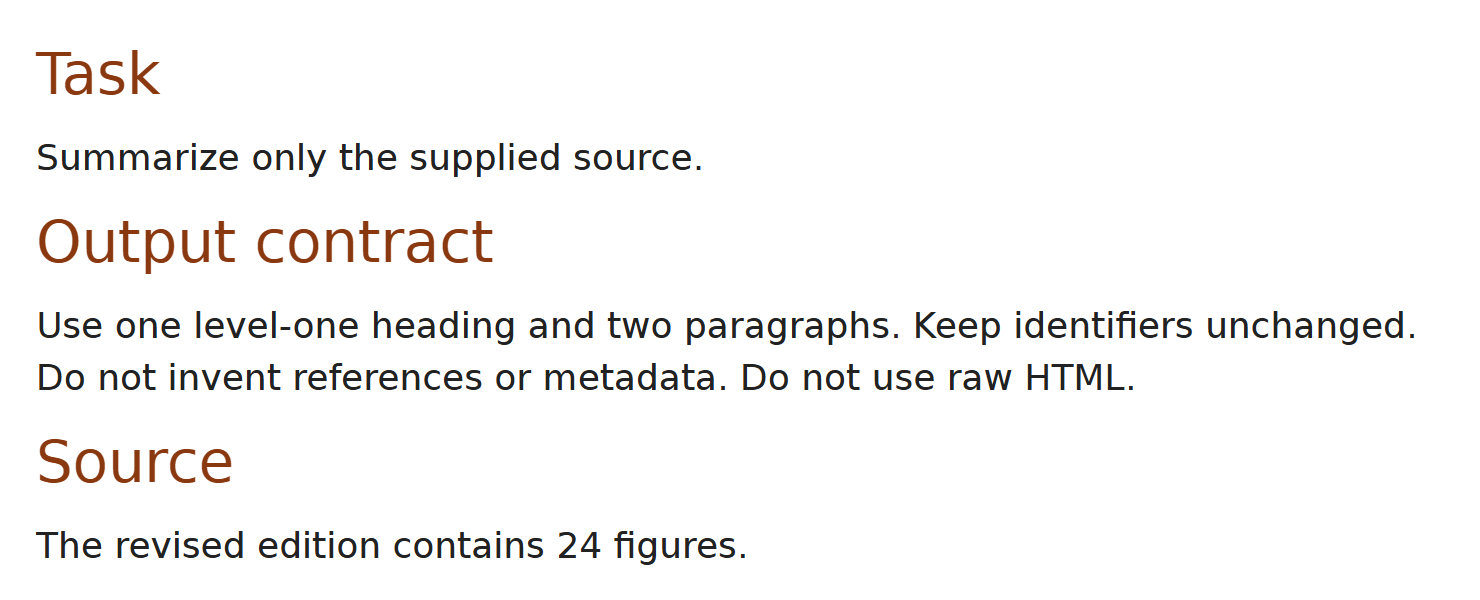
Example 51: A testable Markdown output contract for AI
CommonMark
Headings separate the task, output contract, and source data. XML markup delimits the source document and carries an identifier. This is prompt text, not a model comparison executed here. Its browser rendering only shows how the same text is interpreted as Markdown.
SOURCE
# Task
Summarize only the supplied source.

# Output contract
Use one level-one heading and two paragraphs.
Keep identifiers unchanged.
Do not invent references or metadata.
Do not use raw HTML.

# Source
<document id="guide-01">
The revised edition contains 24 figures.
</document>
RENDERED RESULT
A model response would subsequently need parsing and checks against the contract. Neither clear headings nor XML tags guarantee truthful answers or prevent prompt injection. Treat the source as untrusted data. Facts, identifiers, and references need independent checking before publication.
A useful workflow for generated articles is to identify sources, define an output profile, parse the Markdown, inspect domain content, and only then publish. Successfully parsed text can still contain false references, invented figures, or invalid relationships. Syntax checks, fact checking, and visual quality assurance complement rather than replace one another.