


LinkedIn Profile Analysis: Who Still Develops XSLT?
A Look at Germany and the USA
(Note: the term “XSLT developers” refers to developers of all genders.)
For many years, XSLT has been one of the most important technologies for processing, transforming and automating XML data. Yet XSLT rarely features prominently in current technology discussions. At data2type, we find this an interesting contradiction, because our daily work shows us just how relevant XML and XSLT remain!
Many business-critical processes depend directly or indirectly on XML. These include Office formats such as DOCX and XLSX, InDesign workflows, technical documentation, publishing processes, industry standards, interfaces and numerous internal business data processes.
This prompted us to ask: What is the age distribution of the people working with XSLT today?
Methodology:
Together with our intern Wanja, we analysed XSLT developer profiles in June 2026. We looked at profiles from Germany and the USA. Current ages were estimated from publicly visible information about education, the year in which studies began or the year of birth.
This analysis is not a comprehensive demographic study. However, it provides a clear indication that is consistent with our observations from projects.
Study No. 1 – Germany: Two Thirds Are Aged 40 or Older
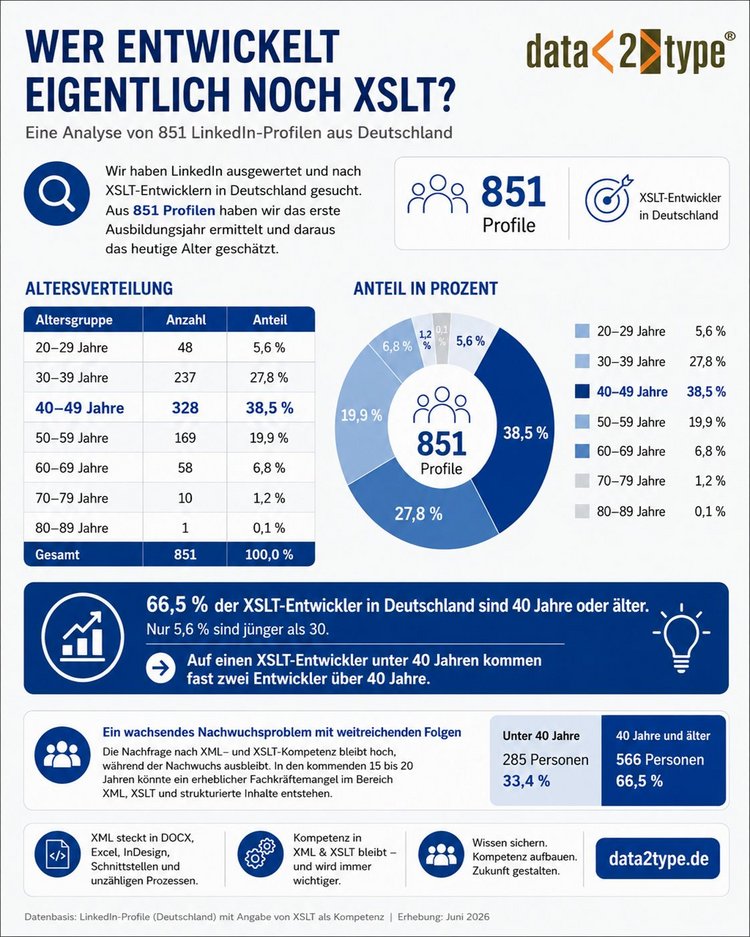
Figure 1: Age distribution of XSLT developers in Germany, based on 851 profiles analysed.
For Germany, we identified and analysed 851 profiles. Current ages were estimated from the year in which vocational training or university studies began.
The largest group is aged 40 to 49. This age group accounts for 38.5 per cent of the profiles analysed. Overall, 66.5 per cent of the XSLT developers identified in Germany are aged 40 or older.
The small proportion of younger developers is particularly striking. Only 5.6 per cent of the people included in the analysis are under 30.
This means that, in Germany, there are almost two developers aged 40 or older for every XSLT developer under 40.
Study No. 2 – USA: The Trend Is Even More Pronounced
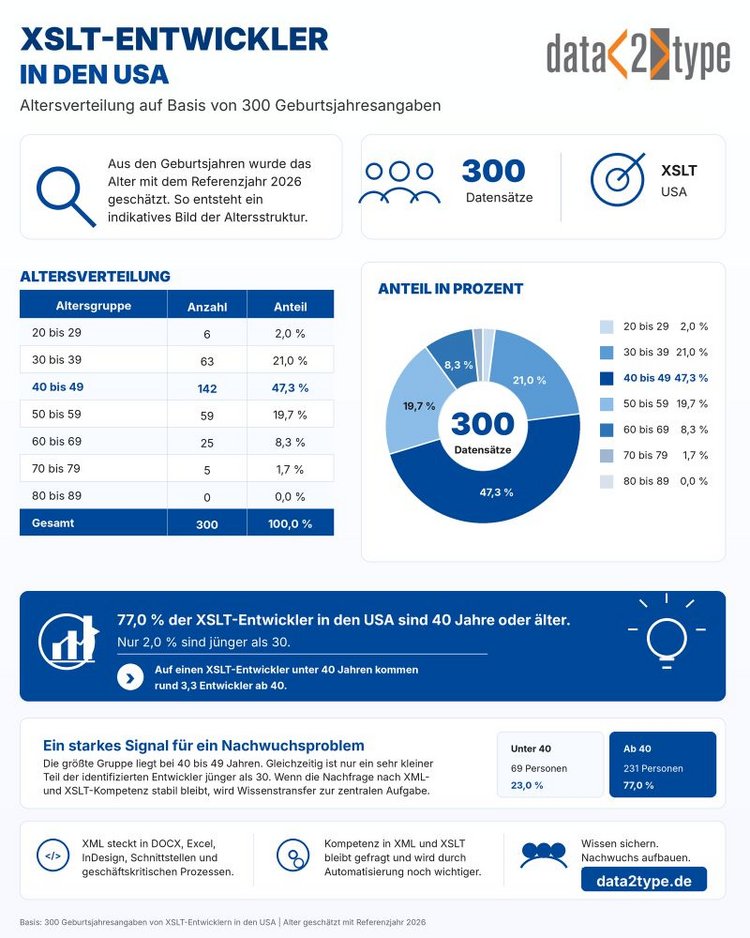
Figure 2: Age distribution of XSLT developers in the USA, based on 300 reported years of birth.
We also carried out a corresponding analysis for the USA. This was based on 300 reported years of birth from XSLT developer profiles. Ages were calculated using 2026 as the reference year.
The result is even more pronounced than in Germany. In the USA, 77.0 per cent of the XSLT developers analysed are aged 40 or older. Only 2.0 per cent are under 30.
Here too, the largest age group is 40 to 49. It accounts for 47.3 per cent of the profiles analysed.
This means that, in the USA, there are around 3.3 developers aged 40 or older for every XSLT developer under 40.
An International Shortage of New Talent!
Germany and the USA show the same pattern: the XSLT community is ageing, while few young developers are joining it.
This is particularly relevant because XML technologies continue to play an important role. XML underpins document formats, editorial systems, publishing workflows, interfaces, norms, standards and data pipelines. Modern applications involving content engineering, structured content, semantic data models and AI-assisted knowledge systems also frequently rely on XML structures.
The demand for XML and XSLT expertise is therefore not disappearing. In many areas, the requirements are actually becoming more demanding.
At the same time, the age distribution suggests that a substantial proportion of experienced developers will retire over the next 10 to 20 years. If their knowledge is not passed on in time, this creates a real risk for companies that rely on XML-based processes.
Why Companies Should Act Now
Many companies use XML systems without realising how much specialist knowledge they contain. Transformations, schemas, stylesheets, publishing pipelines and interfaces often evolve over many years. They form complex process chains that are deeply embedded in the organisation.
When only a few people truly understand these systems, companies risk becoming dependent on them. This affects not only maintenance and further development, but also migrations, automation, quality assurance and the integration of new technologies.
Knowledge transfer therefore becomes a central task. Companies should document their XML landscape early on, identify who maintains the core systems and establish how expertise can be passed on to younger developers.
XSLT Remains a Key Skill
The analysis does not show that XSLT is disappearing. If anything, it shows the opposite: XSLT remains relevant, but people with extensive practical expertise could become harder to find.
For developers, this may present an opportunity. Those who understand XML, XSLT, XPath, XQuery and structured content work in a highly specialised field where their skills are still needed.
For companies, this means that XML expertise should be regarded as strategic knowledge rather than a legacy burden. Wherever documents, data and processes need to be transformed and automated reliably, XSLT remains a powerful tool.
The crucial question, therefore, is not whether XML and XSLT are still needed.
>>> The crucial question is: Who will master this knowledge, pass it on and apply it in modern system landscapes in the future?